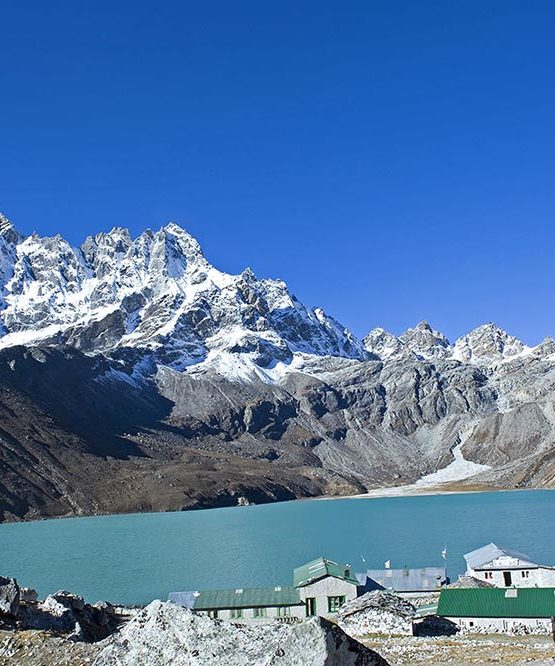
Embark on a once-in-a-lifetime adventure by combining two of Nepal’s most iconic treks: the Everest Base Camp (EBC) and Island Peak Climbing. This combined trek offers the thrill of reaching the Everest Base Camp, at 5,364 meters, followed by the challenge of summiting Island Peak (6,189 meters), one of the most popular climbing peaks in the Khumbu region. Together, these treks offer unparalleled views, breathtaking landscapes, and an unforgettable experience.
This trek allows adventurers to trek to the base of Mount Everest and then conquer the summit of Island Peak (6,189m/20,305ft). The trek typically lasts around 16-19 days, including acclimatization days and the climb itself.
If the peak can be likened to an Island in a glacial sea, than the main land forms a semicircle of cliffs that rise in the north to the rugged summit of Nuptse (7879m/ 25850ft), Lhotse (9501m/27870ft), Lhotse middle peak (8410m/ 27590ft), as yet still unclimbed and Lhotse Shar (8383m/ 27503ft). To the east, rising above the frozen waves of the Lhotse Shar glacier, is Cho polu (6734m/ 22093ft).
Beyond which can be seen the red granite mass of Makalu (8475m/ 27805ft). To the south of the Imja glacier and icy flutings of Baruntse (7720m/ 25328ft) and the Amphu peaks lead the eye to the lofty pinnacle of Ama Dablam (6856m/ 22493ft), which is like a giant sea ·stack guarding the entrance to the glacial bay.
Why Choose EBC Combined with Island Peak Climbing?
The EBC combined with Island Peak Climbing trek is a perfect blend of trekking and mountaineering, ideal for those who want to push their limits. This combination offers an extraordinary opportunity to experience the famous Everest Base Camp trek and then proceed to summit Island Peak, known for its challenging but achievable climb.
The combination allows trekkers to:
Experience Everest Base Camp – Stand at the foot of the world’s highest mountain, surrounded by towering peaks.
Climb Island Peak – Challenge yourself with an exciting and rewarding peak climb.
Unmatched Scenery – Enjoy panoramic views of Everest, Lhotse, Nuptse, Ama Dablam, and other stunning peaks.
Cultural Insights – Discover the rich Sherpa culture in the villages of the Khumbu region.
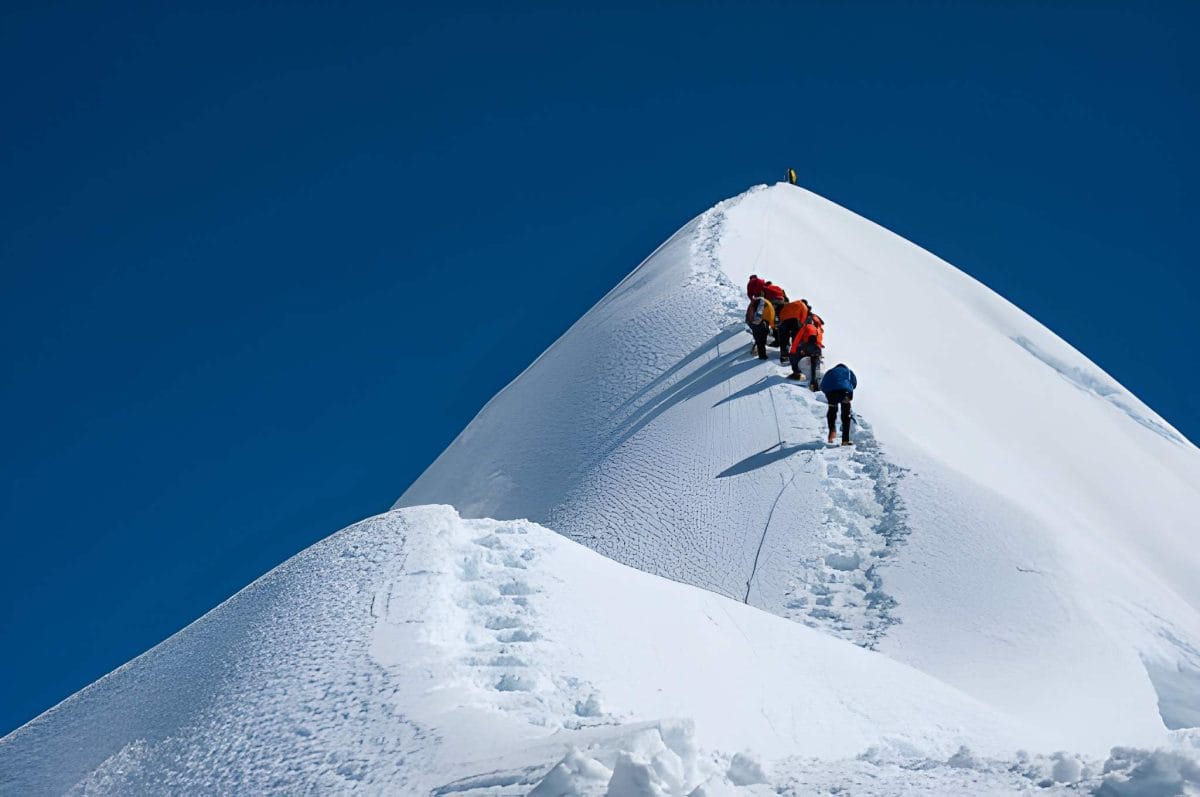
Highlights of the Island Peak climbing
- Summit a Himalayan peak over 6000m
- Approach the Khumbu Valley via Everest Base Camp
- Lodge and tent-based accommodation
- Buddhist Monasteries.
- Sherpa culture and landscape
Guideline Itinerary for Island Peak Climbing
DAY 1: ARRIVE IN KATHMANDU
DAY 2: FLIGHT TO LUKLA – TREK TO PHAKDING
DAY 3: TREK TO NAMCHE BAZAAR
DAY 4: ACCLIMATISATION IN NAMCHE
DAY 5: TREK TO TENGBOCHE
DAY 6: TREK TO PHERICHE
DAY 7: ACCLIMATISATION IN PHERICHE
DAY 8: TREK TO LOBUCHE
DAY 9: TREK TO GORAK SHEP – EVEREST BASE CAMP – GORAK SHEP
DAY 10: ASCEND KALA PATTAR – TREK TO DINGBOCHE
DAY 11: TREK TO CHUKHUNG
DAY 12: TREK TO ISLAND PEAK BASE CAMP
DAY 13: TREK TO HIGH CAMP
DAY 14: ASCENT OF ISLAND PEAK
DAY 15: EXTRA DAY
DAY 16: TREK TO PANGBOCHE
DAY 17: TREK TO NAMCHE
DAY 18: TREK TO LUKLA
DAY 19: FLY TO KATHMANDU
DAY 20: FREE DAY IN KATHMANDU
DAY 21: FINAL DEPARTURE TOWARD YOUR HOMELAND
Detailed Itinerary for Island Peak Climbing
DAY 1: ARRIVE IN KATHMANDU
From Kathmandu Airport, we will arrange a private transfer to your hotel. That night or early the next morning you will meet your local Plan a Trek representative and have a full pre-trek briefing
DAY 2: FLIGHT TO LUKLA – TREK TO PHAKDING
The flight from Kathmandu to Lukla takes 45 minutes and is an adventure in itself with great views of the Everest region (from the left of the plane) and ending with a hair-raising landing on a steep mountain runway. After meeting our crew, we will start our trek by heading up the Dudh Koshi Valley on a well- marked trail to Phakding
DAY 3: TREK TO NAMCHE BAZAAR
From Phakding, we cross and re-cross the river on high suspension bridges. Beyond Monjo is the entrance to the Sagarmatha National Park, which was set up to conserve this fragile mountain environment. We then ascend steeply to Namche and along the way, if the weather permits, catch the first glimpse of Mt Everest. Namche Bazaar is the main trading village in Khumbu and has a busy Saturday market. It is a meeting place for the Hindu traders from the lowlands and Tibetan yak caravans that have crossed the glaciated Nangpa La. You can enjoy an Illy coffee and amazing brownies here!
DAY 4: ACCLIMATISATION IN NAMCHE
Namche is tucked away between two ridges and has lots of lodges, tea shops and souvenir shops. Today we will trek up to the Everest View Hotel at 3880m for our first view of Ama Dablam and Mount Everest. Following the ‘walk high, sleep low’ principle, this hike will really help with your acclimatization
DAY 5: TREK TO TENGBOCHE
From Namche, the trail contours onto the side of the valley, high above the Dudh Koshi. We will get great views of Everest, Lhotse, Nuptse and Ama Dablam. Passing by several villages and numerous tea shops, we descend steeply to a bridge over the river at Phunki Tenga. The village is an ideal stopover for lunch. Here we can rest before making the steep climb to Tengboche, famous for its legendary monastery, the largest in the Khumbu.
DAY 6: TREK TO PHERICHE
We descend through a forest, cross the Imja Khola and climb steadily to the village of Pangboche. This village is directly opposite Ama Dablam (6856m), and has exceptional views of the mountain, the gompa, Mani walls and scattered pine trees. A further two hours walk brings us to Pheriche.
DAY 7: ACCLIMATISATION IN PHERICHE
A day for rest and acclimatization. We also have an opportunity to wander up the valley to look at the Tshola Tsho lake and the perpendicular walls of Cholatse and Tawache. Our guide will take us up onto the ridge overlooking Dingboche for the view of the Imja Valley and the incredible south face of Lhotse.
DAY 8: TREK TO LOBUCHE
We continue up the wide valley beneath the impressive peaks of Cholatse and Tawache on the left. We then turn right and take a steep climb towards the foot of the Khumbu Glacier. The tea house at Duglha is a good spot to have lunch. The trail zigzags up through the boulders of the glacier’s terminal moraine. At the top of this climb, there are many stone cairns, built as memorials to the many Sherpas who have died while climbing Mt Everest. The path then climbs gently along the glacier to eventually reach Lobuche
DAY 9: TREK TO GORAK SHEP – EVEREST BASE CAMP – GORAK SHEP
To reach our next stop, Everest Base Camp, we follow the Khumbu Glacier. The trail offers superb views of the surrounding mountains, especially where the path is forced to rise to cross a tributary glacier. We stop for lunch at Gorak Shep before finally making our way to Base Camp itself (5364m). This takes several hours as the trail weaves its way through ice pinnacles and past the crevasses of the Khumbu Glacier.
DAY 10: ASCEND KALA PATTAR – TREK TO DINGBOCHE
A very early start is required to reach the top of Kala Pattar (5554m) for one of the best viewpoints in the Himalaya. From here, we can see the face of Everest and deep into the Khumbu icefield. After lunch, we then descend to Dingboche for the night.
DAY 11: TREK TO CHUKHUNG
Today we have an easy walk for about 2 hours, climbing up gradually to the small settlement of Chhukhung. Along the way, we have great views of Island Peak and the challenge that awaits us.
DAY 12: TREK TO ISLAND PEAK BASE CAMP
Another easy day, the trail crosses the river and follows the valley for 3 hours, passing beneath the magnificent south face of Lhotse. Base Camp is by the side of the Imja glacier, below steep grassy slopes which mark the start of the climb on Island Peak.
DAY 13: TREK TO HIGH CAMP
We ascend a little further to High Camp, where we will relax and make final preparations for our climb tomorrow.
DAY 14: ASCENT OF ISLAND PEAK
Crossing the gully above the camp, the trail makes a climb for another hour to a narrow ridge, leading on to the glacier. Here it is time to rope up and put on our crampons to begin the glacier crossing. This is followed by the steep snow slope that leads onto the summit ridge. On reaching the summit, we have stunning close-up views of the south face of Lhotse looming over us, while in the other direction, there are more dramatic mountain views. We descend along the same route, down to Base Camp.
DAY 15: Extra day
A contingency day is allocated for poor weather, etc.
DAY 16: TREK TO PANGBOCHE
After descending along the trail to Chukhung, we continue on to Dingboche for lunch. It is then another couple of hours to the village of Pangboche, where we will stay for the night.
DAY 17: TREK TO NAMCHE
From Pangboche, we drop down to follow the river. After crossing it, we climb back up through birch and rhododendron forest back to Tengboche. From Tengboch,e we descend over the Dudh Koshi before making our way back to Namche.
DAY 18: TREK TO LUKLA
Your final day’s trek follows the Dudh Koshi back down to Lukla. This last evening in the mountains is the ideal opportunity for a farewell party with the Sherpa guides and porters, where you can look back on a memorable trekking experience.
DAY 19: FLY TO KATHMANDU
After an early breakfast, we will head to the airstrip for our return journey to Kathmandu.
DAY 20: FREE DAY IN KATHMANDU
A free day in Kathmandu to explore the city at your leisure. The Buddhist stupa of Boudhanath, the Monkey Temple at Swayambhunath and the Hindu temple of Pashupatinath are just some of the religious highlights of this fascinating city.
DAY 21: FINAL DEPARTURE TOWARD YOUR HOMELAND
We will collect you from your hotel and transfer you to Kathmandu International Airport for your departing flight.
Cost including
- Airport pick up and drop off
- Three meals a day (Breakfast, Lunch and Dinner) during the trek.
- Fresh fruits every night after dinner.
- Tented accommodation during the climbing period
- Island Peak Climbing permit
- 3 Night Hotel accommodation in Kathmandu.
- Trekking lodge (Tea House) accommodations during the trek.
- All necessary paperwork, Sagarmatha National Park entry permit & Trekker`s Information Management System (TIMS) permit.
- Peak climbing permit and other necessary fees.
- Camping tent and climbing rope.
- Lukla flight (Kathmandu-Lukla-Kathmandu) including airport tax, pickup and drop.
- A highly experienced, helpful, knowledgeable, friendly, English-speaking, Government license holder trekking guide and climbing Sherpa, with all his salary, food, drinks, accommodation, transport and insurance.
- Strong, helpful porters with proper equipment (one porter for two people) with all their salary, food, drinks, accommodation and insurance.
- Comprehensive medical supplies (first aid kit).
- Arrangement of Emergency Helicopter service (paid by your Travel insurance company).
- Use of sleeping bags, a down jacket, a duffel bag and Walking Poles (to be returned after the trip).
- Government taxes and official expenses.
- Oximeter to check your pulse, oxygen saturation and heart rate twice daily (very useful to check Altitude Mountain Sickness symptoms), which will ensure your trek is in the safest hands possible for all levels of trekker.
- Assistant guide group size above 4+ person.
Cost Exclude
- Your Travel and medical insurance.
- Your International airfare.
- Your personal expenses.
- Cold and hot drinks on trek as desserts and sweet things (those you choose to purchase along the way and during evenings in the Tea Houses)
- Battery charging and a hot shower in the tea houses.
- Personal climbing equipment can be hired for $150 USD per person.
- Tips for the guide, porter and driver (Tipping is expected).
- Excess baggage more than 15kg for the Lukla flight.
When is the best time to trek?
- Sept-October – November and Autumn are Nepal´s peak and best time to go trekking.
- March – May is the second-best season of the year to go trekking.
- December – January -February: the skies are clear, but it can get very cold, and there is a risk of passes being closed due to snowfall.
Equipment Check List
Frequently Asked Questions
1. What is the cost of the EBC combined with Island Peak trek?
The EBC combined with Island Peak trek generally costs between $2,700 and $3,800, including Island Peak climbing permits and guide fees.
2. How difficult is the EBC combined with the Island Peak climbing trek?
The EBC combined with Island Peak trek is challenging due to high altitude and the technical Island Peak climb. Prior trekking experience and physical fitness are crucial for success.
3. What permits are required for the EBC combined with Island Peak trek?
For the Island Peak climb, you’ll need a TIMS Card, Sagarmatha National Park Permit, and an Island Peak Climbing Permit.
4. What is the best time to do the EBC combined with the Island Peak trek?
The ideal time for the EBC combined with Island Peak trek is pre-monsoon (March-May) and post-monsoon (September-November), when the weather is stable and clear.
5. How long does the EBC combined with Island Peak trek take?
The EBC combined with Island Peak trek takes around 18-20 days, including acclimatization and the Island Peak summit.
6. Is previous mountaineering experience necessary for Island Peak Climbing?
While prior mountaineering experience is not required for the EBC combined with Island Peak trek, basic knowledge of using ice axes, crampons, and ropes is recommended for the Island Peak climb.
7. Can I combine the EBC trek with Island Peak in a shorter time?
While possible, shortening the EBC combined with Island Peak trek increases altitude sickness risks. We recommend the full 18-20 days for proper acclimatization.
8. What should I bring on the EBC combined with Island Peak Climbing trek?
Essential gear for the EBC combined with the Island Peak trek includes trekking boots, warm clothing, Island Peak climbing gear (ice axe, crampons), and a first aid kit.