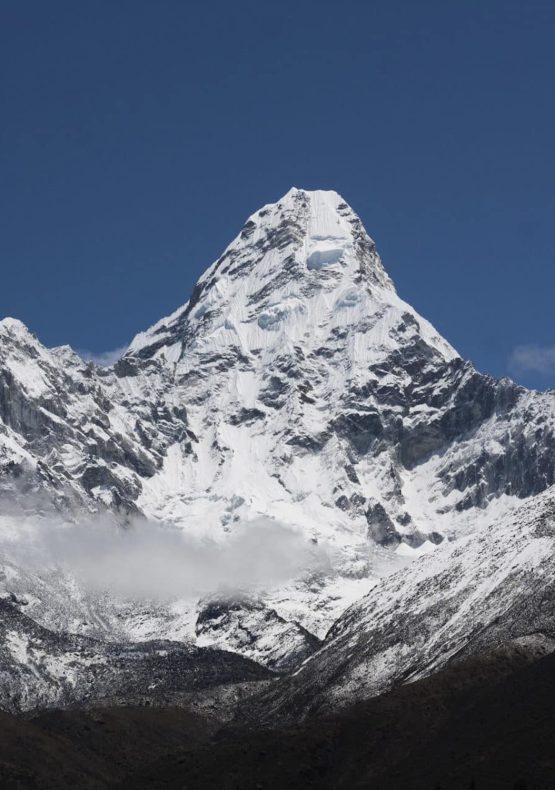
The Tilicho Lake Trek is one of Nepal’s most spectacular high-altitude adventures, taking you to the world’s highest lake at 4,919 meters (16,138 feet). Located in the Annapurna region, this challenging trek combines stunning mountain scenery, rich cultural experiences, and the achievement of reaching one of the planet’s most remarkable natural wonders.
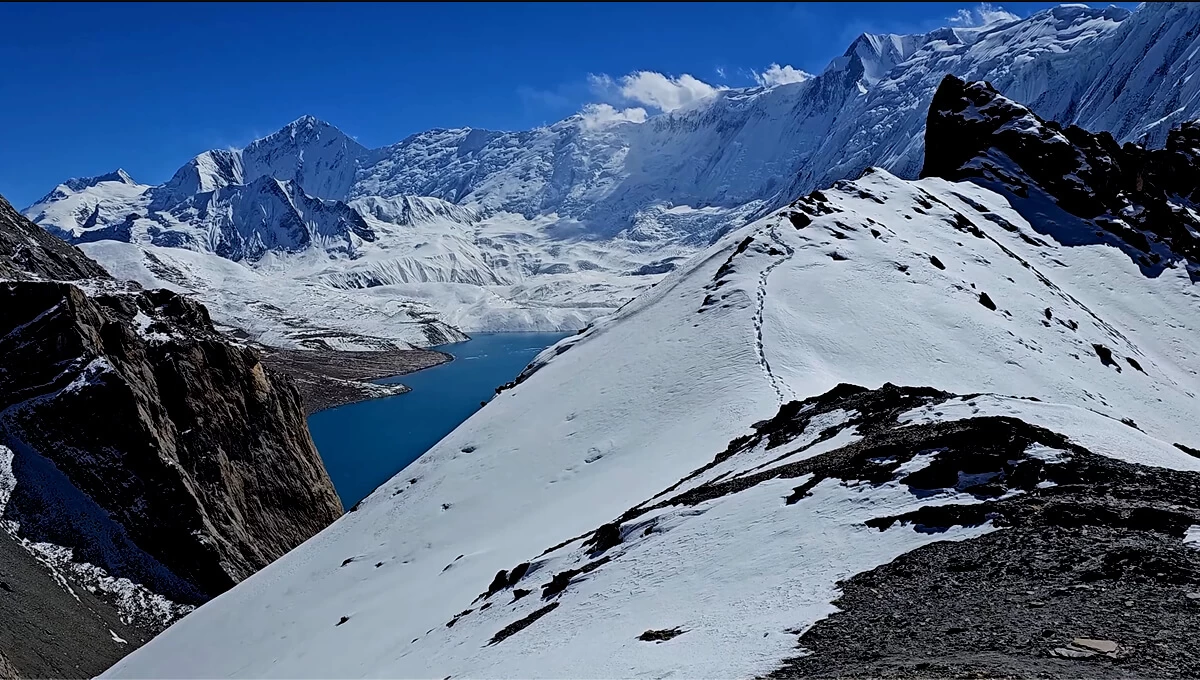
The Tilicho Lake trek typically takes 7-9 days and can be completed as a standalone journey or combined with the classic Annapurna Circuit. Starting from Manang, trekkers ascend through remote valleys to Tilicho Base Camp at 4,150m before making the final push to the turquoise glacial lake surrounded by towering peaks including Tilicho Peak (7,134m), Nilgiri (7,061m), and the Annapurna massif.
At Tilicho Lake altitude of 4,919m, proper acclimatization is essential. This comprehensive guide covers everything you need to know about Tilicho Lake height, temperature conditions, base camp facilities, trekking routes, and the optional Mesokanto La Pass extension for experienced adventurers seeking to continue to Upper Mustang.
Tilicho Lake Trek with Mesokanto La Pass Highlights:
- Trail in the verdant forest of fir, pine, oak, and rhododendron
- ethnic group of people and culture
- Diverse landscapes and Tibetan culture in Manang
- Wonderful Kali Gandaki River, Gangapurna glacier
- Hike to Gangapurna viewpoint
- Magnificent views of Mt. Annapurna, Pisang Peak, Gangapurna, Tilicho Peak, Dhaulagiri, Machhapuchhre, Nilgiri, and Himchuli
- Visit the largest Braka Monastery in the Manang region
- Mesmerizing turquoise blue Tilicho Lake (4919m)
- Thrilling experience traversing Thorong La Pass 5416m
Guideline itinerary for Tilicho Lake Trek with Mesokanto La Pass
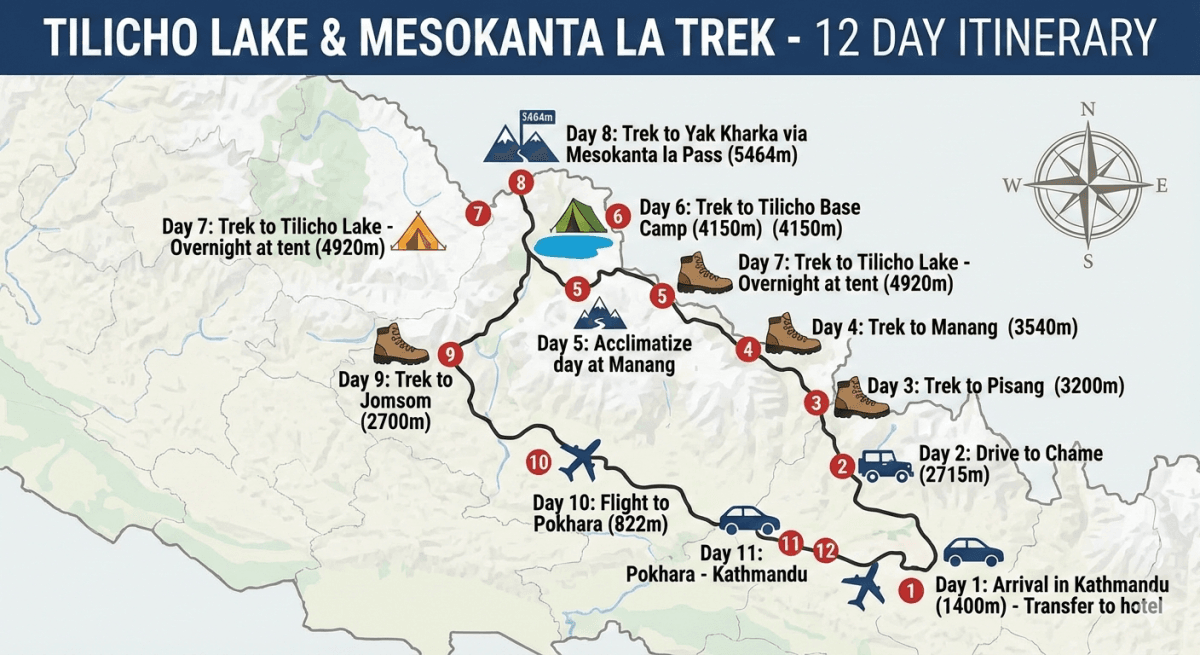
Day 1: Arrival in Kathmandu – Transfer to the hotel
Day 2: Drive to Chame (2715m)
Day 3: Trek to Pisang (3200m)
Day 4: Trek to Manang (3540m)
Day 5: Acclimatize day at Manang
Day 6: Trek to Tilicho Base Camp (4150m)
Day 7: Trek to Tilicho Lake – Overnight at tent (4920m)
Day 8: Trek to Yak Kharka via Mesokanta la Pass (5464m)
Day 9: Trek to Jomson (2700m)
Day 10: Flight to Pokhara
Day 11: Pokhara – Kathmandu
Day 12: Kathmandu – Transfer to the Airport
Would you like to Customize your trip?
What’s Included in Tilicho Lake Trek Itinerary-
- Airport pickup and drop by private vehicle
- 3-star hotel accommodation in Kathmandu with B/B plane
- 3 night hotel in Kathmandu.
- Teahouse accommodation during the trek
- Tented accommodation during the climbing period
- All meals (breakfast, lunch and dinner) during the trek and climbing
- Farewell dinners
- All ground transportation on a comfortable private vehicle as per the itinerary
- English speaking, trained and experienced trekking guide
- Porter service (2 trekkers: 1 porter only Cary 25 Kg)
- Nepal trekking Staff salary, equipment, transportation
- food and accommodation for trekking stuff
- Insurance for Nepali trekking stuff
- Down jacket and sleeping bag (to be returned after trip completion)
- Plan a trek and expedition trekking bag/duffel bag, t-shirt
- Trekking map
- All necessary paper work
- Medical kit (carried by your guide)
- All government and local taxes
Cost Exclude:-
- International flight & departure tax
- Lunch & dinner during stay in Kathmandu.
- Personal climbing gears & clothing, (available on hire).
- Tips, any expenses of personal nature, client’s insurance.
- Emergency evocation
- Any kind of bar bill hot shower, telephone, internet and alcoholic drink
- Hotel in Kathmandu early arrival and late departure
Understanding Tilicho Lake’s 4,919m Altitude
Tilicho Lake sits at an impressive altitude of 4,919 meters (16,138 feet) above sea level, making it one of the highest lakes in the world. The Tilicho Lake Trek altitude is comparable to Mont Blanc in the Alps and presents significant challenges for trekkers due to reduced oxygen levels at this elevation.
At Tilicho Lake height, the air contains approximately 40% less oxygen than at sea level. This means your body must work harder to perform even simple tasks, and proper acclimatization becomes crucial for a safe and enjoyable trek.
Altitude Statistics:
- Tilicho Lake Trek altitude: 4,919m / 16,138 feet
- Tilicho Base Camp altitude: 4,150m / 13,615 feet
- Altitude gain from base camp to lake: 769m / 2,523 feet
- Manang altitude (starting point): 3,540m / 11,614 feet
- Total altitude gain from Manang: 1,379m / 4,524 feet
Is Tilicho Lake Trek the Highest Lake in the World?
While often referred to as “the world’s highest lake,” Tilicho Lake Trek is more accurately one of the highest lakes at its altitude. The highest lake title is disputed and depends on definitions of what constitutes a “lake” versus a pond or small water body. However, Tilicho Lake Trek is undeniably one of the highest significant lakes on Earth and the highest in Nepal.
Other contenders include:
- Ojos del Salado crater lake (6,390m) – but very small
- Several unnamed glacial pools in Tibet and Himalayas
- Lake Licancabur (5,916m) in Bolivia-Chile
Tilicho Lake’s distinction lies in being a substantial lake (4.8 km² surface area) at extreme altitude with established trekking access.
Altitude Sickness Prevention at Tilicho Lake Height
The Tilicho Lake altitude presents genuine risks for altitude sickness (Acute Mountain Sickness – AMS). Understanding and respecting the altitude is essential:
Common Symptoms at Tilicho Lake Altitude:
- Headache and dizziness
- Nausea and loss of appetite
- Fatigue and weakness
- Shortness of breath
- Difficulty sleeping
- Rapid heartbeat
Prevention Strategies:
- Gradual Ascent: Spend at least 2 nights in Manang (3,540m) before ascending
- Acclimatization Day: Take a rest day at Khangsar or Tilicho Base Camp
- Hydration: Drink 4-5 liters of water daily
- Climb High, Sleep Low: If possible, ascend higher during day but sleep at lower altitude
- Medication: Carry Diamox (acetazolamide) after consulting your doctor
- Listen to Your Body: Descend immediately if symptoms worsen
Altitude Gain Guidelines:
Above 3,000m, you should not gain more than 500m in sleeping altitude per day. The Tilicho Lake trek itinerary follows this principle:
- Manang (3,540m) → Khangsar (3,734m) = 194m gain
- Khangsar → Tilicho Base Camp (4,150m) = 416m gain
- Tilicho Base Camp → Tilicho Lake (4,919m) = Day trip, return to base camp
Comparing Tilicho Lake Altitude with Other Treks
Understanding Tilicho Lake height in context:
| Trek/Location | Altitude | Comparison |
|---|---|---|
| Tilicho Lake | 4,919m | Reference point |
| Annapurna Base Camp | 4,130m | 789m lower |
| Everest Base Camp | 5,364m | 445m higher |
| Thorong La Pass | 5,416m | 497m higher |
| Manang | 3,540m | 1,379m lower |
| Kathmandu | 1,400m | 3,519m lower |
The Tilicho Lake altitude is significantly higher than Annapurna Base Camp, making it more challenging. However, it’s lower than Everest Base Camp and Thorong La Pass, making it achievable for trekkers with proper preparation.
Oxygen Levels at Different Altitudes:
- Sea level: 100% oxygen availability
- Manang (3,540m): ~65% oxygen
- Tilicho Base Camp (4,150m): ~60% oxygen
- Tilicho Lake (4,919m): ~55% oxygen
- Thorong La Pass (5,416m): ~50% oxygen
Detail in Programmed for Tilicho Lake Trek
Day 1: Arrival in Kathmandu – Transfer to the hotel
On arrival at Tribhuvan International Airport meet our staff with Plan a trek, transfer to Hotels, our guide will give you a short briefing about the regarding trip at the Hotel.
Day 2: Drive to Chame (2715m)
Early morning drive from Kathmandu to Chame via beshisahar,Jaggat, Dharapani we will arrived at Chame overnight.
Day 3: Trek to Pisang (3200m)
We walk from here follows the other side of the river on the northern bank, after leaving Chame, the path passes through pine woods and small villages with few ups and downs till you reach Bratang. From here trek continues on the gradual path up to a bridge, from the bridge a short steep climb through the pine forest brings you at the top of the ridge of Pisang village. After walking past the tree lines a great view can be seen of Pisang peak and the Chulu peak with Pisang village below, from this ridge a gentle descent for an hour brings to the windswept village of Pisang.
Day 4: Trek to Manang (3540m)
From Pisang onwards, the walks lead with the constant view of the high snow-capped peaks. The walk climbs steeply up for half an hour, after a short gradual walk from the Pisang village then reaching the top of a small hill. This grand spot offers dramatic views of the valleys, Hongdae village with its short air-strip and the great peaks of Gangapurna, Annapurna II, III, Tilocho, and on the right Chuli east, on the back Pisang peak. The walk from here is on the downhill and gradual path all the way to Hongdae, from Hongdae the trek is more or less flat on the wide trail most of the way to Manang, adding a slight touch of altitude as you near to the village of Braga and Manang, here with time to spend the morning visiting Braga Monastery. The largest in the district, it has an outstanding display of statues, thangkas, and religious manuscripts. From here it is only an hour walk to Manang for the overnight stop.
Day 5: Rest day at Manang
A necessary day to rest and acclimatize and explore Manang. The village of about 500 flat-roofed houses, is the picturesque set amongst some spectacular scenery -Annapurna II, Annapurna III [7,555 meters.], Gangapurna [7,454 meters.] to the South – Tilicho [7,132 meters.] and the Grand Barrier to the West – Chulu West [6,583 meters.] and Chulu East [6,059 meters.] to the North.
Day 6: Trek to Tilicho Base Camp (4150m)
Khangsar sees few trekkers, despite being quite accessible from Manang. The medieval village has retained its ancient houses and traditional culture. It has OK lodges but mattresses were thin. As more trekkers discover the attractions of Tilicho Lake, Khangsar should see an increase in trekkers and mattress thickness! Below Manang, down on the northwest side, is a Kani, where a sigh for Tilicho is painted on the rock, indicating right. The trail basically climbs along a ridge and hillside to Khangsar (3734m). The village offers a rare view of the elusive peak of Kang Guru peak that dominates the Nar Phu trek.
Day 7: Trek to Tilicho Lake – Overnight at tent (4920m)
Trek from Tilicho Base Camp to Tilicho lake which one is top of the world highest lake 4,920m from the sea level. It takes about three to four hours from Base camp. It is not available hotel need to sleep in the tent.
Day 8: Trek to Yak Kharka via Mesokanta Pass (5464m)
Early in the morning wake up at 4:30 am and start to walk first part is mostly need to go street and almost 500m climb up and all the way down overnight at Yak Kharka.
Day 9: Trek to Jomson (2700m)
Trek from akhara to Jomsom it takes about 6 hours all the way down each to Jomsom is headquarter of Mustang District and overnight at Jomsom.
Day 10: Flight to Pokhara
A 15-minute morning flight takes us to Pokhara from Jomsom. Once we arrive at Pokhara airport, we then drive to the hotel. In the afternoon we will have a sightseeing tour around Pokhara valley, which covers Fewa Lake, Devi’s Falls, museum, Tibetan refugee settlement and Gupteshower cave, etc. Overnight at a hotel. Breakfast included.
Day 11: Pokhara – Kathmandu
We will be driving back to Kathmandu in the morning in a tourist bus (7-hour trip). If you are interested in extending the trip, there are many options such as Chitwan jungle safari, river rafting adventure, Kathmandu shopping tour, mountain biking, and other activities. In the evening we will have a farewell dinner in a traditional Nepalese restaurant with cultural performances.
Day 12: Kathmandu – Transfer to the Airport
Our Plan a Trek stuff drop you to at the international airport in Kathmandu for your flight departure from Nepal.
Monthly Temperature Breakdown at Tilicho Lake
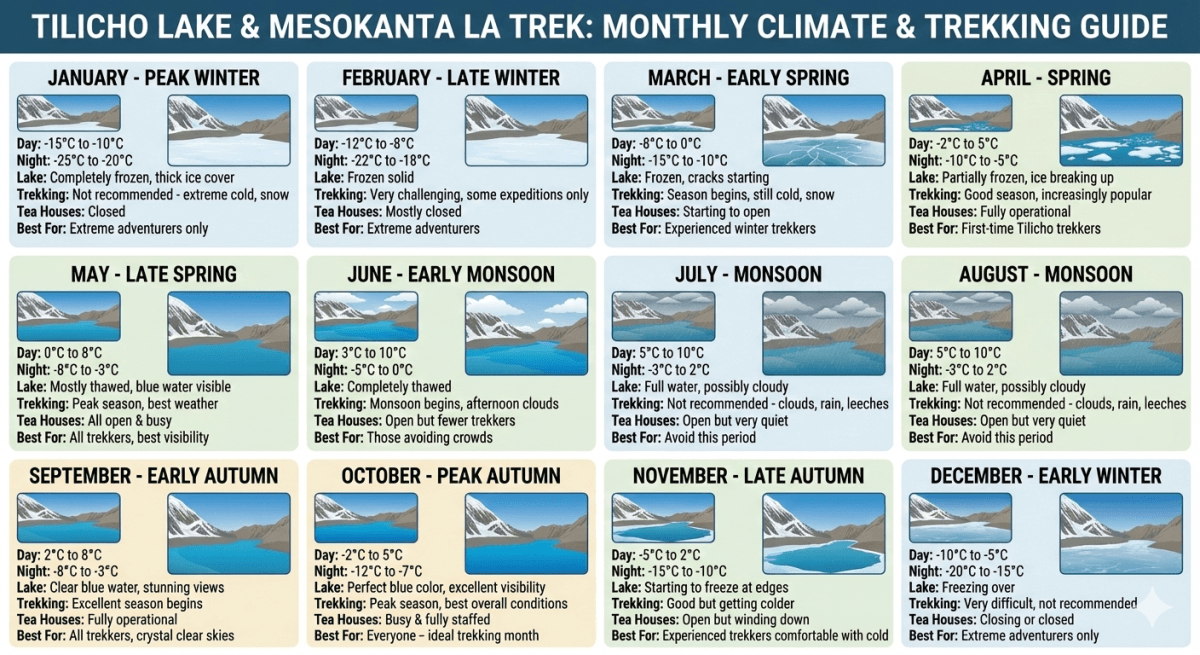
January – Peak Winter
- Daytime Temperature: -15°C to -10°C (5°F to 14°F)
- Nighttime Temperature: -25°C to -20°C (-13°F to -4°F)
- Lake Condition: Completely frozen, thick ice cover
- Trekking: Not recommended – extreme cold, heavy snow, trail closure
- Tea Houses: Closed
February – Late Winter
- Daytime Temperature: -12°C to -8°C (10°F to 18°F)
- Nighttime Temperature: -22°C to -18°C (-8°F to 0°F)
- Lake Condition: Frozen solid
- Trekking: Very challenging, some expeditions only
- Tea Houses: Mostly closed
March – Early Spring
- Daytime Temperature: -8°C to 0°C (18°F to 32°F)
- Nighttime Temperature: -15°C to -10°C (5°F to 14°F)
- Lake Condition: Frozen but starting to show cracks
- Trekking: Season begins, still cold, snow possible
- Tea Houses: Starting to open
- Best For: Experienced winter trekkers
April – Spring
- Daytime Temperature: -2°C to 5°C (28°F to 41°F)
- Nighttime Temperature: -10°C to -5°C (14°F to 23°F)
- Lake Condition: Partially frozen, ice breaking up
- Trekking: Good season, increasingly popular
- Tea Houses: Fully operational
- Best For: First-time Tilicho trekkers
May – Late Spring
- Daytime Temperature: 0°C to 8°C (32°F to 46°F)
- Nighttime Temperature: -8°C to -3°C (18°F to 27°F)
- Lake Condition: Mostly thawed, beautiful blue water visible
- Trekking: Peak season, best weather
- Tea Houses: All open and busy
- Best For: All trekkers, best visibility
June – Early Monsoon
- Daytime Temperature: 3°C to 10°C (37°F to 50°F)
- Nighttime Temperature: -5°C to 0°C (23°F to 32°F)
- Lake Condition: Completely thawed
- Trekking: Monsoon begins, afternoon clouds common
- Tea Houses: Open but fewer trekkers
- Best For: Those avoiding crowds
July & August – Monsoon
- Daytime Temperature: 5°C to 10°C (41°F to 50°F)
- Nighttime Temperature: -3°C to 2°C (27°F to 36°F)
- Lake Condition: Full water, possibly cloudy
- Trekking: Not recommended – clouds, rain, leeches at lower elevations
- Tea Houses: Open but very quiet
- Best For: Avoid this period
September – Early Autumn
- Daytime Temperature: 2°C to 8°C (36°F to 46°F)
- Nighttime Temperature: -8°C to -3°C (18°F to 27°F)
- Lake Condition: Clear blue water, stunning views
- Trekking: Excellent season begins
- Tea Houses: Fully operational
- Best For: All trekkers, crystal clear skies
October – Peak Autumn
- Daytime Temperature: -2°C to 5°C (28°F to 41°F)
- Nighttime Temperature: -12°C to -7°C (10°F to 19°F)
- Lake Condition: Perfect blue color, excellent visibility
- Trekking: Peak season, best overall conditions
- Tea Houses: Busy and fully staffed
- Best For: Everyone – ideal trekking month
November – Late Autumn
- Daytime Temperature: -5°C to 2°C (23°F to 36°F)
- Nighttime Temperature: -15°C to -10°C (5°F to 14°F)
- Lake Condition: Starting to freeze at edges
- Trekking: Good but getting colder
- Tea Houses: Open but winding down
- Best For: Experienced trekkers comfortable with cold
December – Early Winter
- Daytime Temperature: -10°C to -5°C (14°F to 23°F)
- Nighttime Temperature: -20°C to -15°C (-4°F to 5°F)
- Lake Condition: Freezing over
- Trekking: Very difficult, not recommended
- Tea Houses: Closing or closed
- Best For: Extreme adventurers only
Temperature at Tilicho Base Camp
Tilicho Base Camp at 4,150m is approximately 5-7°C warmer than the lake itself:
- Spring/Autumn daytime: 0°C to 10°C
- Spring/Autumn nighttime: -10°C to -5°C
- Summer daytime: 5°C to 15°C
- Winter daytime: -12°C to -5°C
What the Temperature Means for Your Trek
Packing Recommendations by Season:
Spring/Autumn (Best Seasons):
- 4-season sleeping bag (-15°C rated)
- Down jacket (800+ fill)
- Thermal base layers (2-3 sets)
- Insulated pants
- Warm hat and gloves
- Waterproof outer layers
Summer (Monsoon):
- 3-season sleeping bag
- Light down jacket
- Rain gear essential
- Quick-dry clothing
Winter (Not Recommended):
- Extreme cold weather gear required
- -20°C rated sleeping bag
- Multiple insulation layers
- Face protection
Frequently Asked Question’s
1. What is Tilicho Lake Trek x Mesokanto La Pass Trek?
The Tilicho Mesokanto La Pass Trek is an advanced 12-16 day adventure combining Tilicho Lake (4,919m) with the challenging Mesokanto La Pass (5,099m) crossing into Upper Mustang, designed for experienced high-altitude trekkers.
2. How long does Tilicho Lake Trek take?
The complete trek takes 12-16 days from Kathmandu, including 7-8 days to Tilicho Lake, 2-3 days for pass crossing, and 3-5 days through Upper Mustang.
3. What is the altitude of Mesokanto La Pass?
Mesokanto La Pass sits at 5,099 meters (16,729 feet), making it 180 meters higher than Tilicho Lake and requiring excellent acclimatization.
4. Is Tilicho Mesokanto La Pass Trek difficult?
Yes, it’s very difficult, requiring previous high-altitude experience above 4,500m, excellent fitness, technical skills, and camping experience in extreme conditions.
5. What is the best time for Tilicho Mesokanto La Pass Trek?
Late May to early June and mid-September to October offer the most stable weather and safest pass-crossing conditions.
6. How much does Tilicho Mesokanto La Pass Trek cost?
The trek costs USD $2,200-3,500 per person, including permits (Upper Mustang $500), guide, camping equipment, meals, and transportation.
7. What permits are required for Tilicho Mesokanto La Pass Trek?
You need ACAP (NPR 3,000), TIMS Card (NPR 2,000), and Upper Mustang Restricted Area Permit (USD $500 for 10 days).
8. Do I need camping for Tilicho Mesokanto La Pass Trek?
Yes, camping is mandatory for 2-3 days during pass crossing as there are no tea houses between Tilicho Base Camp and Mustang side.